Link Building in 2026: 9 White-Hat Strategies That Still Work
Link building is the process of earning links from other websites to your own. Links still help Google discover your pages and judge how trusted they are, and in 2026 the same mentions also shape which brands AI tools like ChatGPT and Google AI Mode recommend. The strategies that work now are white-hat ones: creating something worth linking to and getting it in front of the right people. This guide covers nine of them, the links to avoid and how to measure results.
Key Takeaways
- Relevance and trust beat volume. One link from a respected site in your industry is worth more than dozens from unrelated directories.
- The best links are earned editorially. Digital PR, original data, expert commentary and genuinely useful resources earn links that last.
- Buying links for rankings breaks Google’s rules. Paid and sponsored links must carry a rel="sponsored" or rel="nofollow" attribute.
- Quick wins exist. Unlinked brand mentions, broken links and supplier or partner pages are often the fastest links to secure.
- Links now support AI visibility too. Mentions on trusted sites help AI tools understand and recommend your brand.
- White-hat link building works at speed. One client’s Domain Rating grew from 12 to 41 in 100 days, and another’s from 18 to 44 in four months with a 340% rise in organic revenue.
Is Link Building Still Important in 2026?
Yes, link building is still important in 2026. Links help Google find new pages and act as a signal of trust and authority, especially in competitive markets where many pages have similar content. Links are not the only factor, and they cannot rescue weak content, but sites with strong, relevant backlinks consistently find it easier to rank.
What has changed is what counts. Google’s systems are far better at ignoring low-quality and manipulative links than they were a decade ago, so the payoff now comes from links that real people would actually click. At the same time, AI search tools build their answers from the sources they trust, which makes mentions on respected sites useful twice: once for rankings and once for AI visibility. I cover the AI side in SEO vs GEO vs AEO.
The key point is that link building has shifted from collecting links to earning reputation. That is the approach behind my off-page SEO work.
What Makes a Good Backlink?
A good backlink comes from a relevant, trusted website that real people visit, sits naturally inside the main content of the page, uses descriptive anchor text and was placed editorially rather than paid for. It should make sense to a reader even if search engines did not exist.
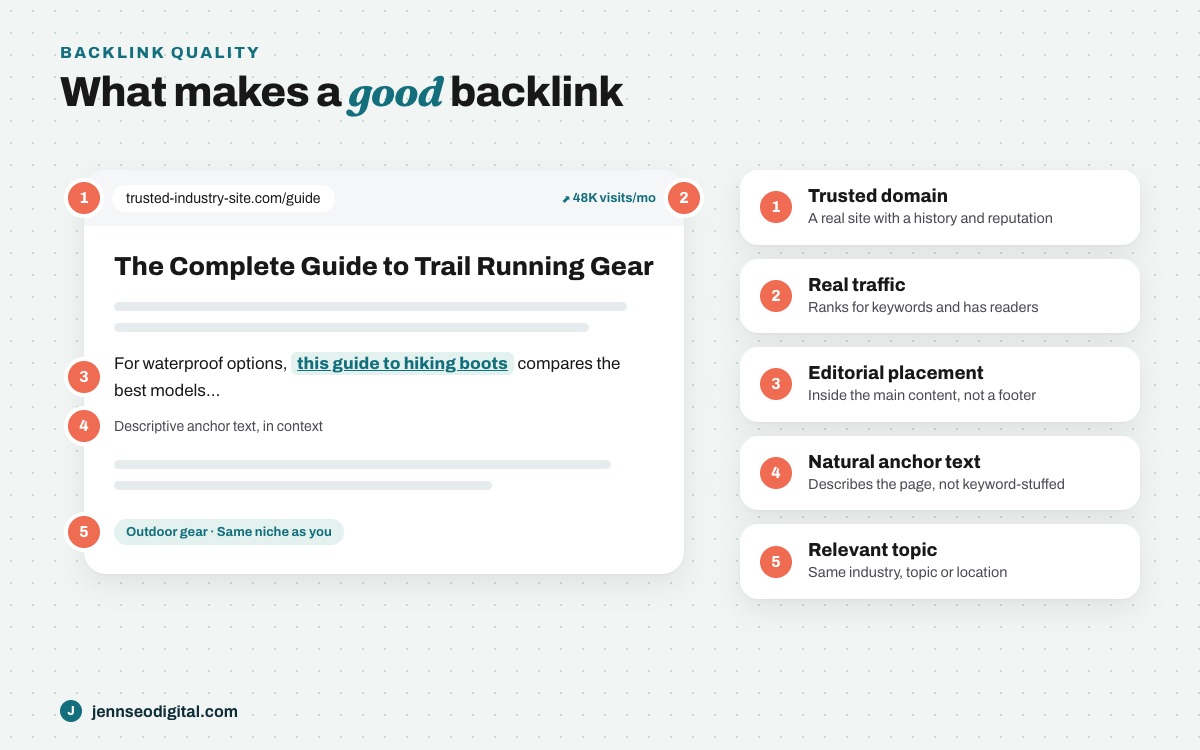
- Relevance: the linking site covers your industry, topic or location.
- Real traffic: the site ranks for keywords and gets visitors. A high Domain Rating with no traffic is a warning sign.
- Editorial placement: the link sits in the body of an article, not in a footer, sidebar or a page of hundreds of links.
- Natural anchor text: a mix of brand names, page titles and descriptive phrases. Exact-match keyword anchors on every link look manipulative.
- A dofollow link where it is earned: nofollow links still bring traffic and mentions, but Google treats them as hints rather than votes.
The bottom line is to judge every link opportunity by asking whether it would still be worth having if it never affected your rankings.
Link Building Strategies at a Glance
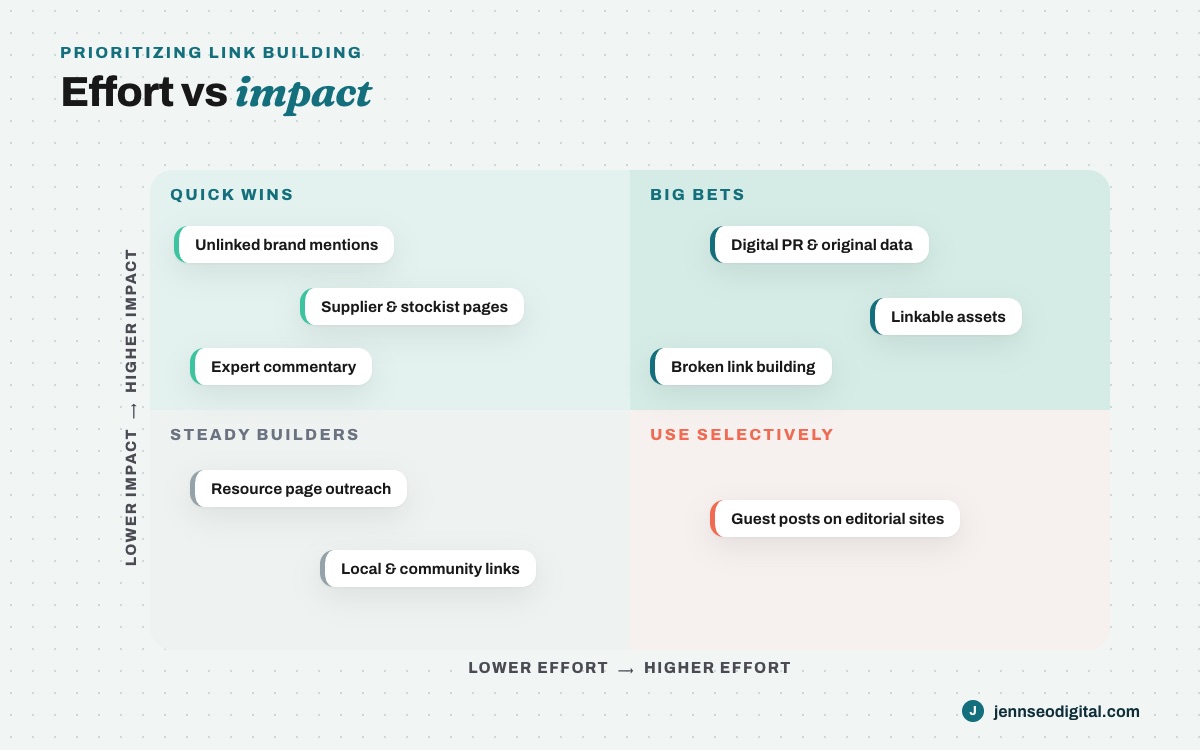
The nine white-hat link building strategies in this guide range from quick wins, such as unlinked mentions and supplier pages, to bigger investments, such as digital PR and original research. The table below compares them by effort, typical link quality and who they suit best.
| Strategy | Effort | Link quality | Best for |
| Unlinked brand mentions | Low | Medium–high | Brands already getting press or reviews |
| Supplier, partner and stockist pages | Low | Medium | Ecommerce stores and manufacturers’ resellers |
| Broken link building | Medium | Medium–high | Sites with strong existing guides |
| Resource page outreach | Medium | Medium | Educational and how-to content |
| Expert commentary for journalists | Medium | High | Founders and specialists |
| Guest contributions | Medium | Medium | B2B, SaaS and service businesses |
| Local and community links | Medium | Medium | Local and service-area businesses |
| Linkable assets | High | High | Any site in a competitive niche |
| Digital PR and original data | High | Very high | Brands that need authority fast |
1. Digital PR and Original Data
Digital PR earns links by giving journalists a story worth covering, usually original data, a survey, a study or a newsworthy expert angle. Because the links come from news and industry publications, they are among the most authoritative links you can earn, and they also build brand mentions that AI tools pick up.
Good campaigns answer a question journalists in your niche already care about. An ecommerce brand might analyse its own sales data to show seasonal buying trends, while a SaaS company might survey its users about a common industry problem. Publish the findings on your site with clear charts and a short summary, then pitch the most interesting angle to relevant writers. Digital PR takes more work than other tactics, but one good campaign can earn dozens of high-quality links.
2. Expert Commentary for Journalists
Expert commentary earns links by answering journalists’ requests for quotes on platforms such as Qwoted and Featured. Writers post questions they need expert answers to, and the best, most specific responses get quoted with a link back to the expert’s website.
Speed and specificity win here. Reply quickly, answer the exact question, include a concrete example or number, and keep it short enough to paste straight into an article. Generic answers rarely get used. This works especially well for founders, consultants and specialists in finance, health, law, ecommerce and technology.
3. Linkable Assets
A linkable asset is a page designed to be referenced, such as a free tool, calculator, template, statistics page, in-depth guide or original diagram. These pages attract links over time because other writers cite them when they need a source.
The best assets fill a gap: the calculator nobody in your niche has built, the statistics roundup that is actually up to date, or the guide that explains a complex topic more clearly than anything else that ranks. Promote the asset once with outreach, then let it keep earning links through search. The SEO audit checklist on this site is an example of the format.
4. Broken Link Building
Broken link building means finding links on other websites that point to pages that no longer exist, then suggesting your own relevant page as a replacement. The site owner fixes a broken experience for their readers, and you earn a link.
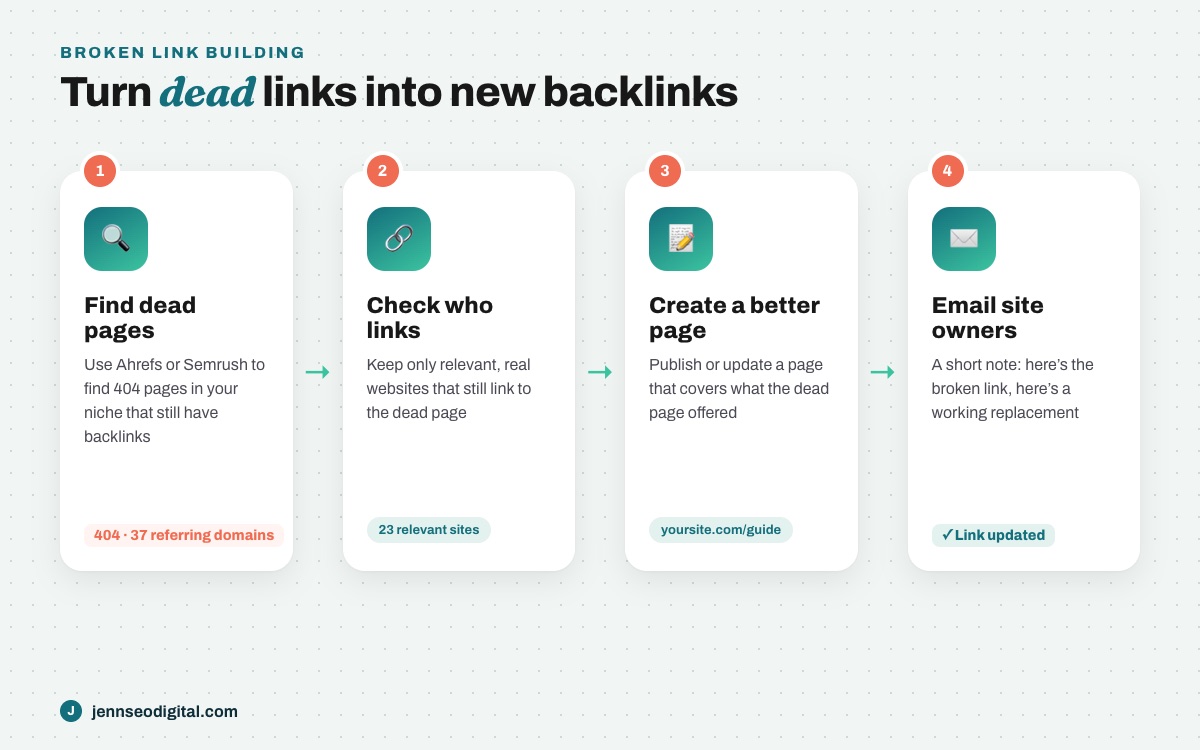
- Find dead pages with links in your niche using the broken pages or best-by-links reports in Ahrefs or Semrush.
- Check who links to them and keep only relevant, real websites.
- Create or match a better page that covers what the dead page used to offer.
- Email the site owners with a short note pointing out the broken link and offering your page as a replacement.
Run the same check on your own site, too. Pages you deleted or moved may have backlinks pointing at a 404 error, and a simple 301 redirect recovers that value instantly.
5. Unlinked Brand Mentions
Unlinked brand mentions are articles, reviews or roundups that name your business without linking to it. Because the writer already chose to mention you, asking them to add a link is one of the easiest outreach requests you can make.
Search for your brand name, product names and founder’s name with Google Alerts or a mention monitoring tool, then send a friendly note thanking the writer and asking if they could link the mention to the most relevant page. Keep it short and make it easy by including the exact URL.
6. Supplier, Partner and Stockist Pages
Supplier, partner and stockist pages are pages on other companies’ websites that list the businesses they work with, such as “where to buy,” “find an installer,” “integrations” or “our partners” pages. If you already have the relationship, the link is often just an email away.
List every manufacturer you stock, software you integrate with, agency you partner with and association you belong to, then check whether each has a page like this. For ecommerce stores, brand stockist pages are some of the most relevant links available, because they come straight from the makers of the products you sell.
7. Resource Page Outreach
Resource pages are curated lists of useful links on a topic, often published by universities, libraries, associations, councils and niche blogs. If you have a genuinely helpful guide or tool, it may deserve a place on them.
Find them with searches like “your topic” + “useful resources” or “your topic” + “helpful links”, check that the page is maintained and relevant, and suggest your resource with one sentence on why it helps their readers. Only pitch content that is educational rather than sales-led.
8. Guest Contributions
Guest contributions are articles you write for other relevant websites, usually with a link in your author bio or within the content where it genuinely helps the reader. They work best when the site has a real audience in your industry and an editor who reviews what gets published.
Guest posting has a bad reputation because of mass-produced articles on sites that exist only to sell links. Google’s spam policies specifically name large-scale article campaigns with keyword-rich anchor text as link spam. Write fewer, better pieces for publications your customers actually read, and treat the audience as the main reward.
9. Local and Community Links
Local and community links come from organisations in your area, such as chambers of commerce, trade associations, local news sites, schools, sports clubs and charities. For businesses that serve a specific area, these links signal relevance to that location as well as trust.
Join the associations you qualify for, take part in local events, offer expert comment to local journalists and publish useful local guides. If you sponsor something in exchange for a link, the link should carry a rel="sponsored" attribute. My local SEO checklist covers how these links fit alongside your Google Business Profile and reviews.
Which Links Should You Avoid?
Avoid links that exist only to manipulate rankings. Google’s spam policies name buying or selling links that pass ranking credit, excessive link exchanges, automated link-building programs, private blog networks, large-scale guest posting with keyword-rich anchors and hidden or low-quality directory and forum links as link spam.
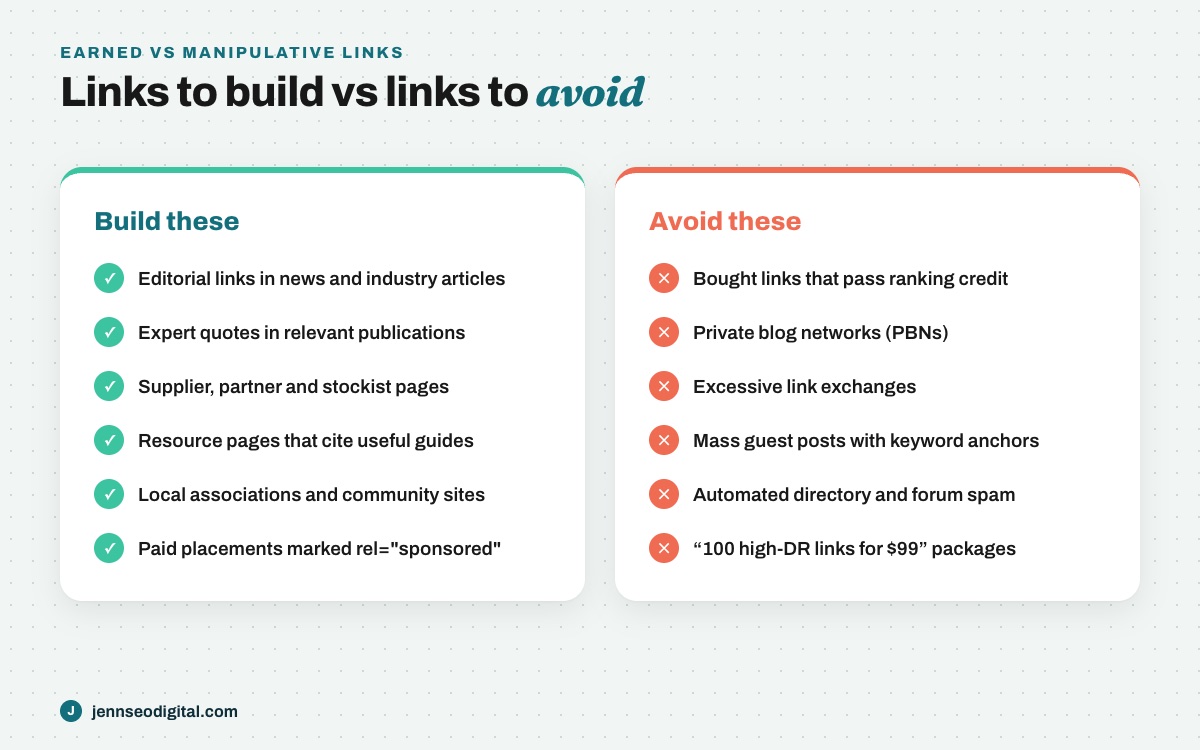
Be wary of any link seller promising a set number of “high DR” links per month for a low fixed price. Those links usually come from sites built to sell links, with inflated metrics and no real readers. At best Google ignores them; at worst they lead to a manual action that removes your rankings.
If you pay for a placement, such as an advertorial or a sponsored review, Google’s guidance on qualifying outbound links says it should carry a rel="sponsored" attribute. That keeps the placement within the rules while still bringing referral traffic and brand exposure.
The key point is that a few earned links will always outperform a large number of bought ones, and they carry no risk. My guide on hiring an SEO expert lists more red flags to watch for when choosing a provider.
How Do You Measure Link Building Results?
Measure link building by tracking new referring domains, the quality and relevance of each linking site, rankings and organic traffic for the pages you built links to, referral traffic and, ultimately, organic revenue or leads. Domain Rating or Authority Score is useful as a rough guide, but it is a third-party metric, not a Google ranking factor.
Two results from my own client work show what a focused campaign can do. A brand-new tech hobbyist store grew its Domain Rating from 12 to 41 in 100 days with high-authority link building alongside on-page work, reaching $150K+ in revenue in four months. An Australian tech accessories brand grew from DR 18 to 44 in four months through white-hat link building, with a 340% increase in organic revenue.
The bottom line is to report links against the business results they support. Clear SEO reporting connects new links to the rankings, traffic and revenue that followed.
Working With a Link Building Specialist
If you would rather have an expert handle outreach, I’m Jenn, an SEO specialist who builds white-hat links for ecommerce, SaaS and service businesses through digital PR, expert commentary, linkable assets and relationship-led outreach. Every link is earned from a real, relevant website.
You can explore my off-page SEO and link building services, see how digital PR earns coverage from respected publications, browse more case studies, or request a free SEO audit that includes a backlink review.
Frequently Asked Questions
What is link building in SEO?
Link building in SEO is the process of getting other websites to link to yours. Search engines use links to discover pages and as a signal of trust and authority, so earning links from relevant, respected websites can help your pages rank higher. White-hat link building focuses on earning those links through useful content and outreach.
How many backlinks do I need to rank?
There is no set number of backlinks needed to rank. Look at the pages already ranking for your target keyword and compare how many referring domains they have and how relevant those sites are. In low-competition niches a handful of good links can be enough, while competitive keywords may need dozens or more.
Is buying backlinks against Google’s rules?
Yes, buying backlinks that pass ranking credit is against Google’s spam policies. Paid links are allowed only when they are marked with a rel="sponsored" or rel="nofollow" attribute, which tells Google not to count them for rankings. Sites that buy followed links risk having those links ignored or receiving a manual action.
Do nofollow links help SEO?
Nofollow links can still help SEO indirectly. Google treats nofollow as a hint rather than a strict rule, and these links can bring referral traffic, brand awareness and mentions that AI tools notice. They usually pass less ranking value than followed editorial links, so a natural profile includes both.
How long does it take for backlinks to work?
Backlinks usually take a few weeks to a few months to affect rankings. Google first needs to crawl the linking page, and the effect builds as more links accumulate. New sites and competitive keywords tend to take longer, which is why link building works best as a steady, ongoing effort rather than a one-off push.
What is the difference between white-hat and black-hat link building?
White-hat link building earns links by creating useful content and asking relevant sites to reference it, within Google’s guidelines. Black-hat link building tries to manipulate rankings with paid links, private blog networks, link exchanges or automated spam. Black-hat tactics can work briefly but risk penalties, while white-hat links keep their value.
Can I do link building myself?
Yes, you can do link building yourself, starting with unlinked brand mentions, supplier and partner pages, local associations and expert commentary requests. These need time and good communication more than special tools. A specialist helps most with digital PR campaigns, large-scale outreach and competitive niches where every link needs to count.