Local SEO Checklist: How to Rank in the Google Map Pack in 2026
Local SEO is the process of making a business show up when nearby customers search for what it offers, especially in the Google Map Pack, the three map listings that appear above the regular results. Google ranks local results on three things: relevance, distance and prominence. This checklist covers how to improve each one, starting with your Google Business Profile and working out to reviews, citations, location pages and links, in the order I use with local clients.
Key Takeaways
- Google ranks local results on relevance, distance and prominence. You cannot change where a searcher is standing, so your work goes into the other two.
- Your Google Business Profile is the foundation. The right primary category, complete details and regular updates matter more than any other single local factor.
- Reviews affect both rankings and clicks. Google confirms that review count and rating factor into local ranking.
- Consistent NAP data builds trust. Your business name, address and phone number should match everywhere they appear online.
- Your website still matters. Strong service and location pages, local schema and links from local sites support your Map Pack rankings.
- There is no paid shortcut. Google states there is no way to request or pay for a better local ranking.
How Does Google Rank Local Businesses?
Google ranks local businesses on relevance, distance and prominence. Relevance is how well your profile matches the search, distance is how far you are from the searcher or the location in the search, and prominence is how well known and trusted your business is, based on reviews, links, articles and your organic rankings.
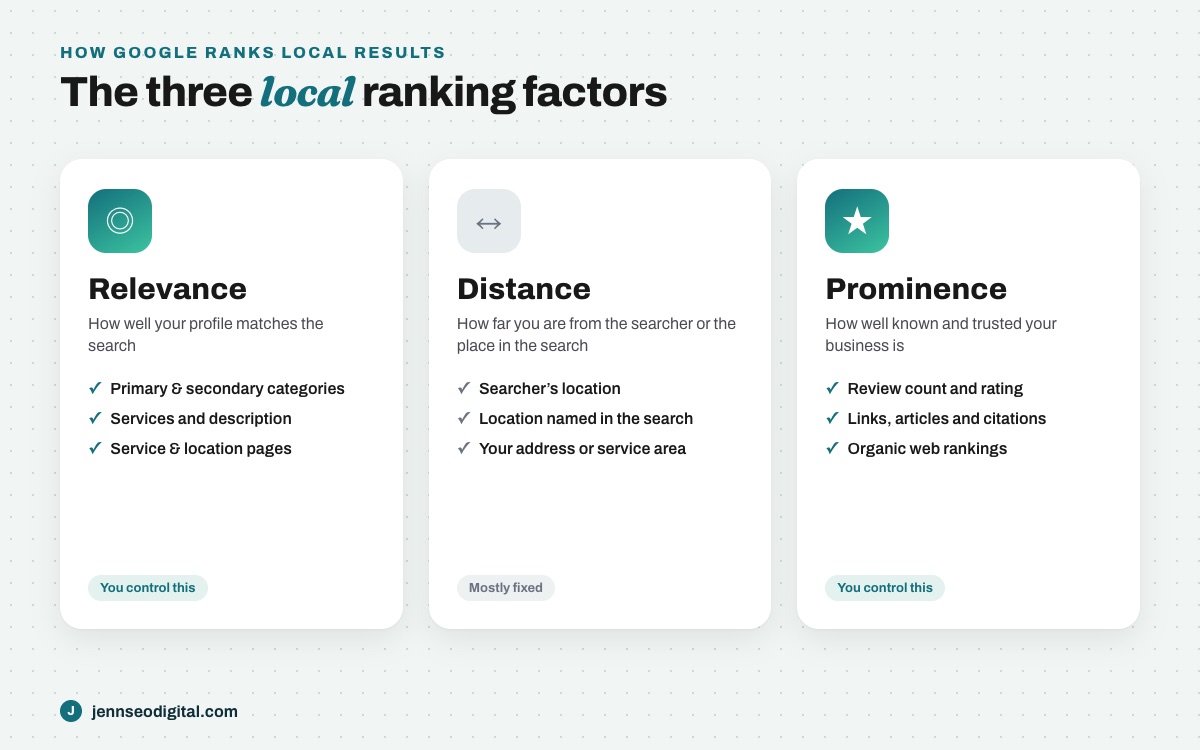
These factors come straight from Google’s own guide, Tips to improve your local ranking on Google. The same page says that review count and score factor into local ranking, that your position in web results also counts toward prominence, and that there is no way to request or pay for a better local ranking.
Distance is mostly out of your hands. A plumber two kilometres away will usually outrank you for a searcher standing next door to them. What you can do is make your business the most relevant and most trusted option within the radius Google is willing to show.
The key point is that local SEO is not a single setting. It is a set of relevance and prominence signals that add up, which is what local SEO work focuses on.
Local SEO Checklist at a Glance
A complete local SEO checklist covers six areas: your Google Business Profile, reviews, NAP consistency and citations, your website’s service and location pages, local links and mentions, and tracking. The table below shows what to check in each area.
| Area | What to check |
| Google Business Profile | Verified, correct primary category, relevant secondary categories, complete hours, services, photos and description, regular updates |
| Reviews | Steady flow of new reviews, replies to every review, no incentives or gated requests |
| NAP and citations | Same name, address and phone on your website, Apple Business Connect, Bing Places, Facebook and key directories |
| Website | Service pages, location or area pages, local keywords in titles and H1s, LocalBusiness schema, embedded map, fast mobile pages |
| Links and mentions | Local news, associations, suppliers, community organisations and industry directories |
| Tracking | Business Profile performance, calls and form leads in GA4, rankings checked from multiple points in your service area |
The bottom line is to start with your Google Business Profile and reviews. They have the most direct effect on the Map Pack and are the quickest to improve.
How Do You Optimize Your Google Business Profile?
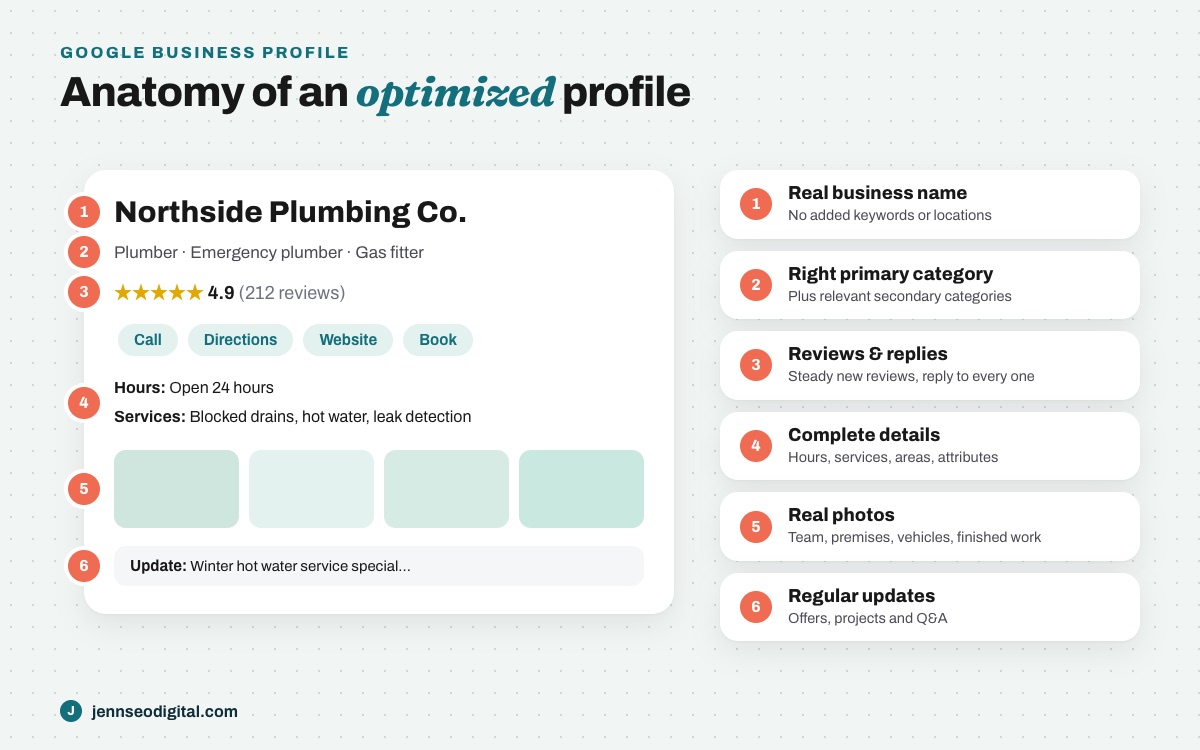
To optimize your Google Business Profile, verify it, choose the most accurate primary category, add relevant secondary categories, fill in every field including services, hours, service areas and attributes, upload real photos, write a clear description and keep the profile active with updates and review replies. Use your real business name with no added keywords.
- Verify the profile. Unverified profiles may not show reliably in Maps or the Map Pack.
- Pick the right primary category. Local SEO practitioners consistently rate it as one of the strongest Map Pack factors. Choose the category that describes your main service, such as “Emergency plumber” rather than just “Contractor,” if it fits.
- Add secondary categories for the other services you genuinely offer. Do not add categories for work you do not do.
- Use your real business name. Google’s guidelines for representing your business say the name should match your real-world signage and branding. Adding keywords or locations to the name can get the profile suspended.
- Complete every field: hours, holiday hours, services with short descriptions, products, attributes, booking links and service areas.
- Hide your address if customers do not visit you. Service-area businesses, such as mobile cleaners or tradies, should list service areas instead of a public address.
- Upload real photos of your team, premises, vehicles and finished work. Stock images do not build trust.
- Post updates and answer questions. Offers, recent projects and seasonal updates keep the profile current and give searchers more reasons to choose you.
The key point is that a complete, accurate profile in the right category does more than any trick. Many businesses lose Map Pack spots simply because a competitor’s profile is more complete.
How Do Reviews Affect Local SEO?
Reviews affect local SEO in two ways. Google states that review count and rating factor into local search ranking, and reviews strongly influence whether searchers click and call. A steady flow of recent, genuine reviews, with a reply from the business on each one, is one of the clearest prominence signals you can build.
- Ask every happy customer. Send your direct review link by SMS or email right after the job, while the experience is fresh.
- Make it easy. Add a QR code to invoices, receipts and the counter, and a review link to your email signature.
- Reply to every review, positive and negative. Google recommends responding to reviews, and a calm, helpful reply to a bad review often reassures future customers more than the review itself worries them.
- Never buy or incentivize reviews. Offering discounts for reviews, or only asking customers you know are happy (review gating), breaks Google’s policies and can lead to reviews being removed.
- Aim for consistency, not bursts. Twenty reviews in one week followed by nothing for six months looks less natural than a few every week.
The bottom line is that reviews are a system, not a campaign. Build the request into your normal job workflow so it happens every time.
What Is NAP Consistency and Why Do Citations Matter?
NAP consistency means your business name, address and phone number appear the same way everywhere online. Citations are any mentions of your NAP on other websites, such as directories, maps apps and social profiles. Consistent citations confirm to Google that your business is real and located where you say it is.
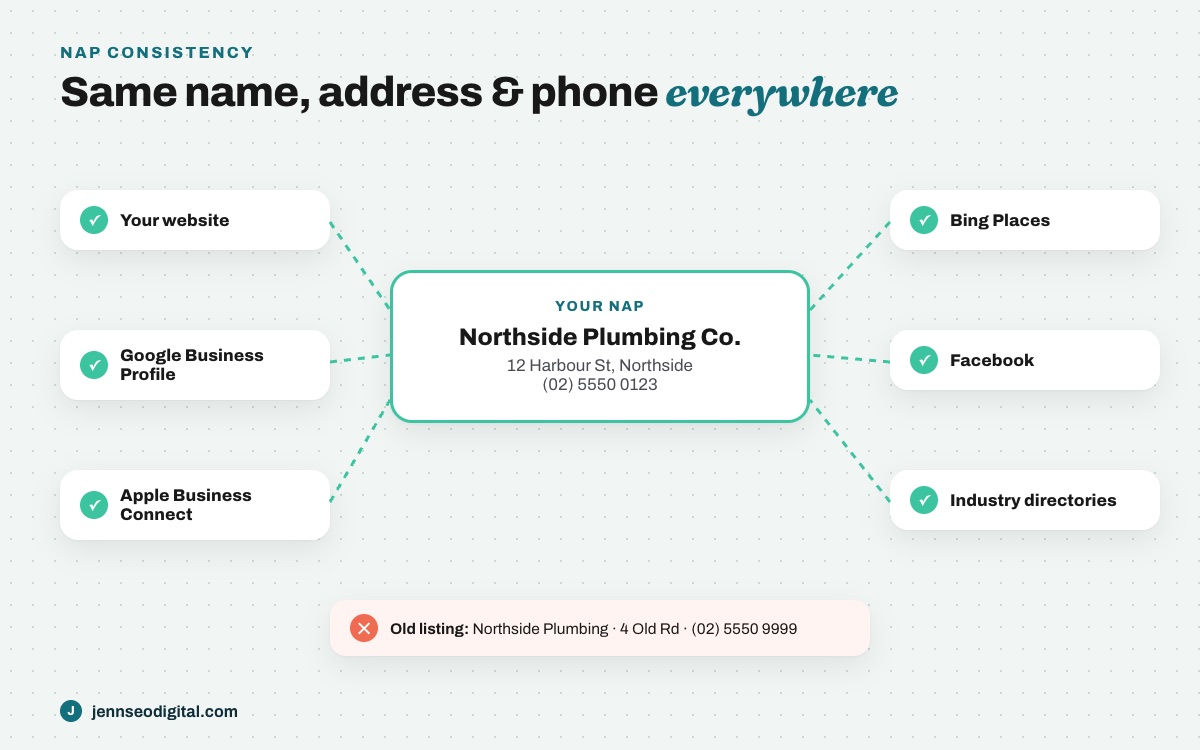
Start with the platforms that power other search and maps experiences:
- Apple Business Connect for Apple Maps and Siri.
- Bing Places for Business for Bing, Bing Maps and Microsoft Copilot.
- Facebook and Instagram business profiles.
- Major directories in your country, such as Yelp, Yellow Pages or True Local, depending on where you operate.
- Industry directories relevant to your trade or profession, such as legal, medical or trade association listings.
When you move, change phone numbers or rebrand, update your website and Google Business Profile first, then work through every other listing. Old, conflicting listings are one of the most common problems I find in a local SEO audit.
The key point is that citations are less about volume and more about accuracy. Ten correct, relevant listings are worth more than a hundred automated ones with mismatched details.
How Do You Optimize Your Website for Local SEO?
To optimize your website for local SEO, create a dedicated page for each core service, add location or service-area pages with genuinely local content, include your city or region in titles and H1s where it fits naturally, show your NAP in the footer, add LocalBusiness structured data, embed a map on your contact page and make sure pages load fast on mobile.
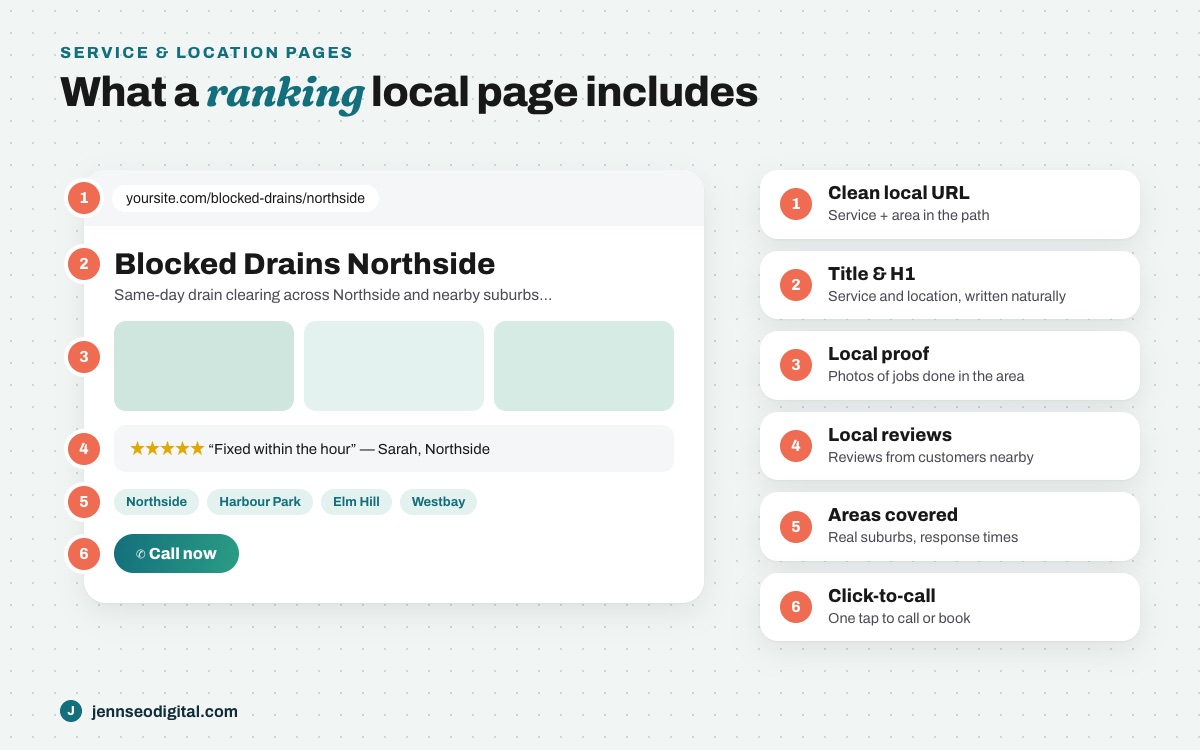
- One page per service. A single “Services” page cannot rank for “blocked drain repair,” “hot water installation” and “gas fitting” at the same time.
- Location pages with real substance. Include projects completed in that area, local reviews, the suburbs covered, response times and photos. Pages that only swap the city name are thin content and rarely rank.
- Local keywords in the right places. Use the service and location in the title tag, H1, URL and intro, written for people first. Good on-page SEO makes this read naturally.
- LocalBusiness schema. Add local business structured data with your name, address, phone, hours and geo-coordinates, matching your Google Business Profile.
- Link your profile to the right page. Point your Google Business Profile website link to the most relevant page, usually the homepage or the matching location page for multi-location businesses.
- Mobile speed and click-to-call. Most local searches happen on phones, so make calling or booking one tap away.
The bottom line is that your website feeds the relevance and prominence of your profile. Local businesses with strong service pages often rank in both the Map Pack and the organic results below it. If your site has crawl or speed issues, fix them first with technical SEO.
How Do You Build Local Links and Mentions?
To build local links and mentions, get listed with your chamber of commerce and trade associations, ask suppliers and partners for a link, support local events and charities, share useful data or expert comment with local news sites, and create genuinely helpful local guides. Links from respected sites in your area are strong prominence signals.
- Associations and memberships: chambers of commerce, trade bodies and licensing boards often list members with a link.
- Suppliers, manufacturers and partners: many have “find an installer” or “stockist” pages.
- Local news and blogs: offer expert comment on seasonal issues, such as storm damage, pest season or tax deadlines.
- Community involvement: sports clubs, schools and charity events. Paid sponsorship links should carry a rel="sponsored" attribute.
- Helpful local content: cost guides, checklists and area guides that local sites want to reference.
The key point is that local links do not need to come from huge websites. A link from your city’s business association can matter more to a local plumber than one from a national site with no connection to the area. My guide to white-hat link building strategies covers these tactics in more detail.
How Do You Show Up in AI Search for Local Queries?
To show up in AI search for local queries, keep your Google Business Profile, Apple Business Connect and Bing Places listings accurate, build reviews on multiple platforms, earn mentions on local news, directory and “best of” pages, and publish clear service pages that answer common questions about price, availability and service areas.
People now ask ChatGPT, Google AI Mode and Gemini questions like “who is the best emergency electrician near me.” Those answers draw on map listings, reviews and the pages that mention local businesses. The same signals that build Map Pack rankings feed AI recommendations. Read SEO vs GEO vs AEO for how AI tools choose which businesses to cite, and see how AI SEO builds on that.
The bottom line is that accurate, consistent and well-reviewed businesses are easier for both Google and AI tools to recommend.
How Do You Track Local SEO Results?
To track local SEO results, use the Performance report in your Google Business Profile for searches, calls, direction requests and website clicks, track calls and form leads as conversions in GA4, monitor organic traffic to service and location pages in Google Search Console, and check Map Pack rankings from several points across your service area.
Map Pack rankings change depending on where the searcher is, so checking from your office only gives you part of the picture. Grid-based rank trackers show how your ranking changes across a map of your service area, which makes it much easier to see where you are strong and where you need location pages or more local links. Clear SEO reporting ties these numbers back to calls and enquiries, which is what actually matters.
Working With a Local SEO Specialist
If you would rather have an expert work through this checklist with you, I’m Jenn, an SEO specialist who helps service businesses and multi-location brands get found by local customers. I work with tradies and contractors, home service businesses, clinics and franchises, and I focus on the calls and enquiries local SEO brings in, not just rankings.
You can explore my local SEO services, see how I approach small business SEO, or request a free SEO audit of your website and Google Business Profile.
Frequently Asked Questions
How do I get my business in the Google Map Pack?
To get your business in the Google Map Pack, verify your Google Business Profile, choose the most accurate primary category, complete every field, collect genuine reviews and reply to them, keep your name, address and phone number consistent online, and build service and location pages on your website. Distance also matters, so you will rank most easily near your location.
How long does local SEO take?
Local SEO usually shows early improvements within one to three months, especially after fixing an incomplete Google Business Profile or wrong category. Competitive markets, such as lawyers or plumbers in large cities, often take six months or more of steady review growth, content and local links to reach the top three.
Can I do local SEO myself?
Yes, many small businesses can do the basics of local SEO themselves. Completing your Google Business Profile, asking for reviews, fixing directory listings and writing service pages need time more than technical skill. A specialist helps most with competitive markets, multi-location businesses, technical website issues and link building.
Does Google Business Profile help SEO?
Yes, Google Business Profile is the most important part of local SEO. It controls whether and how your business appears in the Map Pack and Google Maps, and it shows reviews, photos, hours and services directly in search results. A complete, active profile also sends more clicks and calls to your business.
Do I need a website for local SEO?
You can appear in Google Maps without a website, but a website makes local SEO much stronger. Google uses your position in web results as part of prominence, and service and location pages help you rank for more searches. A website also gives you somewhere to send customers who want details before they call.
Should I add keywords to my Google Business Profile name?
No, do not add keywords to your Google Business Profile name. Google’s guidelines say the name should match how your business appears in the real world, such as on signage and stationery. Adding keywords or locations can get your profile suspended and can be reported by competitors, which undoes your local SEO progress.
How many reviews do I need to rank locally?
There is no fixed number of reviews you need to rank locally. Compare yourself with the businesses already in the Map Pack for your main searches and aim to match or beat their review count over time. Recent reviews and replies matter too, so a steady flow of new reviews works better than one big push.