SEO vs GEO vs AEO: What’s the Difference and Which Does Your Business Need?
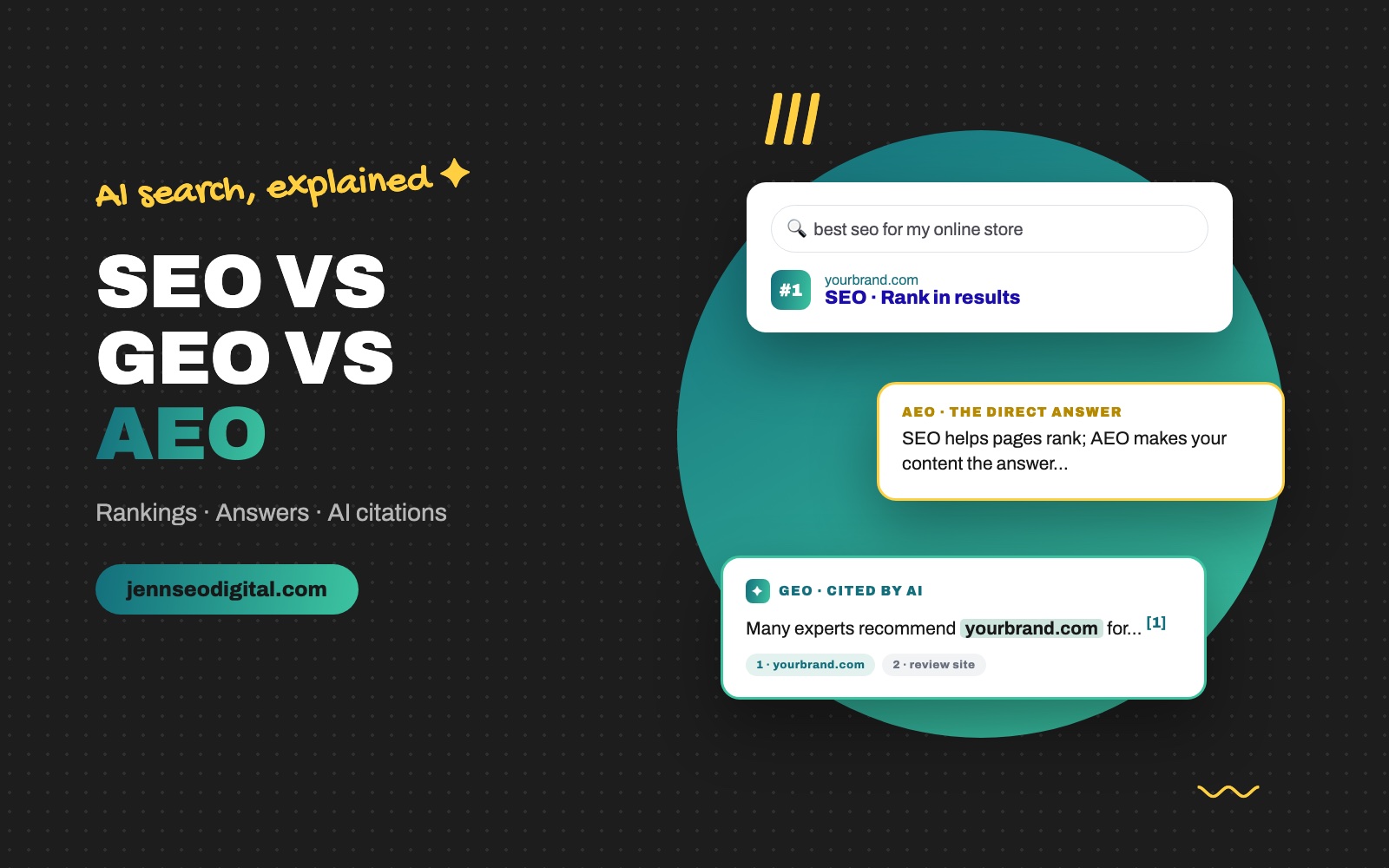
SEO, GEO and AEO are three layers of the same goal: getting your business found when people search. SEO (search engine optimization) helps your pages rank in Google’s results. AEO (answer engine optimization) helps your content become the direct answer in featured snippets, voice search and AI Overviews. GEO (generative engine optimization) helps your brand get cited and recommended inside AI-generated answers from tools like ChatGPT, Perplexity, Gemini and Google AI Mode. Most businesses need all three, and SEO is the foundation the other two are built on.
Key Takeaways
- SEO earns rankings, AEO earns answers, GEO earns citations — each one targets a different part of how people search in 2026.
- GEO and AEO are built on SEO, not a replacement for it. Google says there are no extra requirements to appear in AI Overviews or AI Mode beyond being indexed and eligible for a snippet.
- AI search is now mainstream: OpenAI reported 900 million weekly ChatGPT users in February 2026, and Google’s AI Overviews reach billions of searchers every month.
- Research behind GEO from Princeton, Georgia Tech, the Allen Institute for AI and IIT Delhi found that optimizing content can raise visibility in generative engine answers by up to 40%.
- The content that gets cited answers a question in the first one or two sentences, backs claims with sources and statistics, and comes from a brand that is clearly identified across the web.
- Which one to prioritize depends on how your customers search — but for most local and ecommerce businesses, the right order is SEO first, then AEO, then GEO.
What Is the Difference Between SEO, GEO and AEO?
The difference between SEO, GEO and AEO is where your content shows up. SEO targets the ranked list of blue links, AEO targets the single direct answer (featured snippets, People Also Ask, voice assistants and AI Overviews), and GEO targets the sources that AI chatbots cite and recommend when they write a full answer.
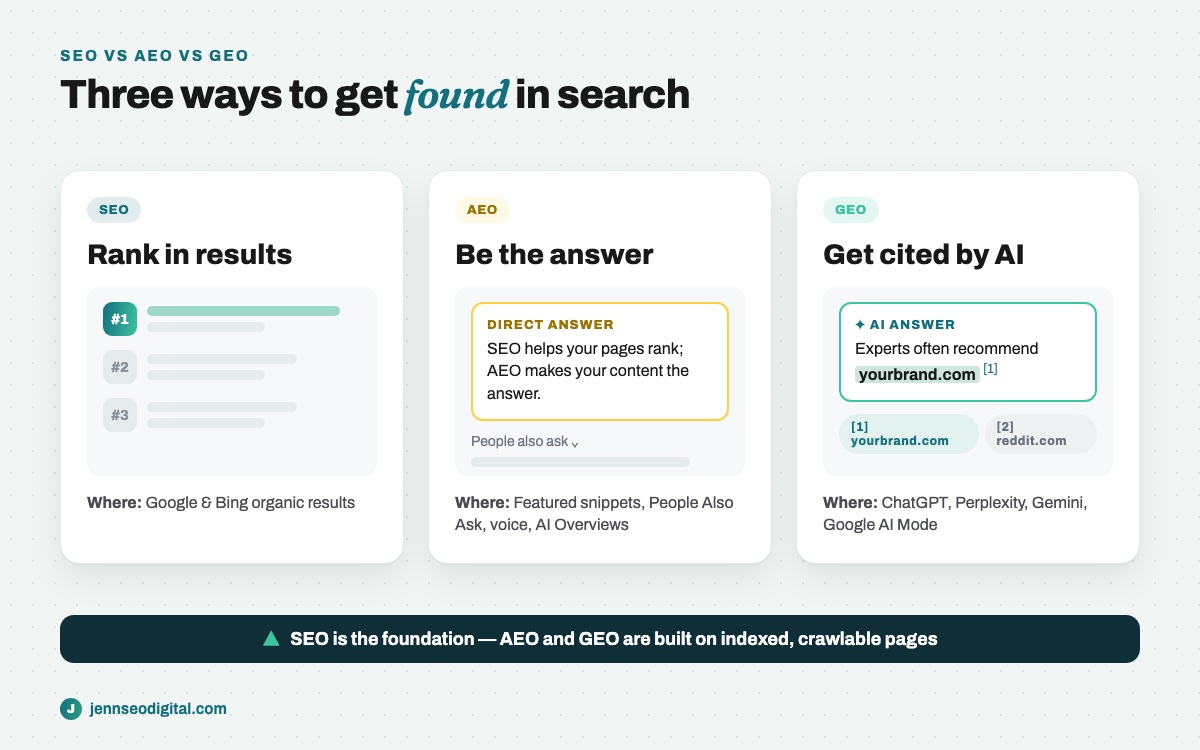
Think of it as the same customer asking the same question in three different places. On Google, they scroll a list of results — that is classic SEO. In a featured snippet or voice search, they get one answer read back to them — that is AEO. In ChatGPT or Perplexity, they get a written recommendation that names a few brands and links to its sources — that is GEO.
| SEO | AEO | GEO | |
| Full name | Search engine optimization | Answer engine optimization | Generative engine optimization |
| Goal | Rank pages in search results | Become the direct answer | Get cited and recommended in AI answers |
| Where it shows | Google and Bing organic results | Featured snippets, People Also Ask, voice assistants, AI Overviews | ChatGPT, Perplexity, Gemini, Claude, Google AI Mode |
| Main success metric | Rankings, clicks, organic traffic | Snippet ownership, answer visibility | Brand mentions and citations in AI responses |
| Key tactics | Technical health, keywords, content, backlinks | Question-based headings, concise answers, structured data | Entity clarity, statistics and sources, mentions on trusted sites |
The key point is that these are not competing strategies. A page that ranks well (SEO), answers questions clearly (AEO) and is cited by trusted sources (GEO) wins in all three places at once.
What Is SEO (Search Engine Optimization)?
SEO, or search engine optimization, is the practice of improving a website so it ranks higher in search engines like Google and Bing for the searches your customers make. It covers technical health, keyword targeting, on-page content and authority from backlinks, and it remains the foundation for every other form of search visibility.
SEO has four classic pillars: technical SEO (making sure search engines can crawl and index your site), keyword research (finding what customers actually search for), on-page SEO (titles, headings, content and internal links) and off-page SEO (links and mentions from other websites). If you are not sure how healthy your site is today, start with an SEO audit checklist.
The bottom line is that without SEO, AI tools have very little to work with: Google’s AI features pull from pages that are already indexed, and most AI chatbots retrieve live search results before they write an answer.
What Is AEO (Answer Engine Optimization)?
AEO, or answer engine optimization, is the practice of structuring content so search engines and assistants can lift it as the direct answer to a question. It targets featured snippets, People Also Ask boxes, voice assistants like Siri and Google Assistant, and the short summaries in Google’s AI Overviews.
AEO is mostly about format. Answer engines favour content that states the answer immediately, in plain language, under a heading that matches the question. In practice, that means:
- Question-based headings that mirror how people search, such as “How much does SEO cost?”
- A direct answer in the first 40–60 words under each heading, before any detail or nuance.
- Lists, steps and tables for processes and comparisons, which are easy to extract.
- Structured data (such as FAQ, HowTo, Product and Organization schema) that matches the visible content.
The key point is that AEO rewards clarity. If a reader can find the answer to their question in five seconds, so can an answer engine.
What Is GEO (Generative Engine Optimization)?
GEO, or generative engine optimization, is the practice of making your brand and content more likely to be cited, summarized or recommended inside AI-generated answers from tools like ChatGPT, Perplexity, Gemini, Claude and Google AI Mode. Instead of competing for a ranking position, you compete to be one of the few sources an AI chooses to reference.
The term comes from a 2023 research paper, GEO: Generative Engine Optimization, by researchers from Princeton University, Georgia Tech, the Allen Institute for AI and IIT Delhi, later published at KDD 2024. The authors tested content changes against a benchmark of real queries and found that GEO methods could boost a source’s visibility in generative engine responses by up to 40%, with results varying by topic.
The stakes have grown quickly. OpenAI reported 900 million weekly active ChatGPT users in February 2026, and back in 2024 Gartner predicted traditional search engine volume would drop 25% by 2026 as AI chatbots became substitute answer engines. Whether or not that exact number lands, more buying journeys now start with a question to an AI assistant.
How Do AI Search Engines Choose Which Sources to Cite?
AI search engines choose sources by running one or more searches behind the scenes, retrieving pages that are indexed and relevant, and then citing the sources that answer each part of the question most clearly and credibly. Pages that are easy to understand, well-structured and backed by evidence are the easiest for an AI to quote.
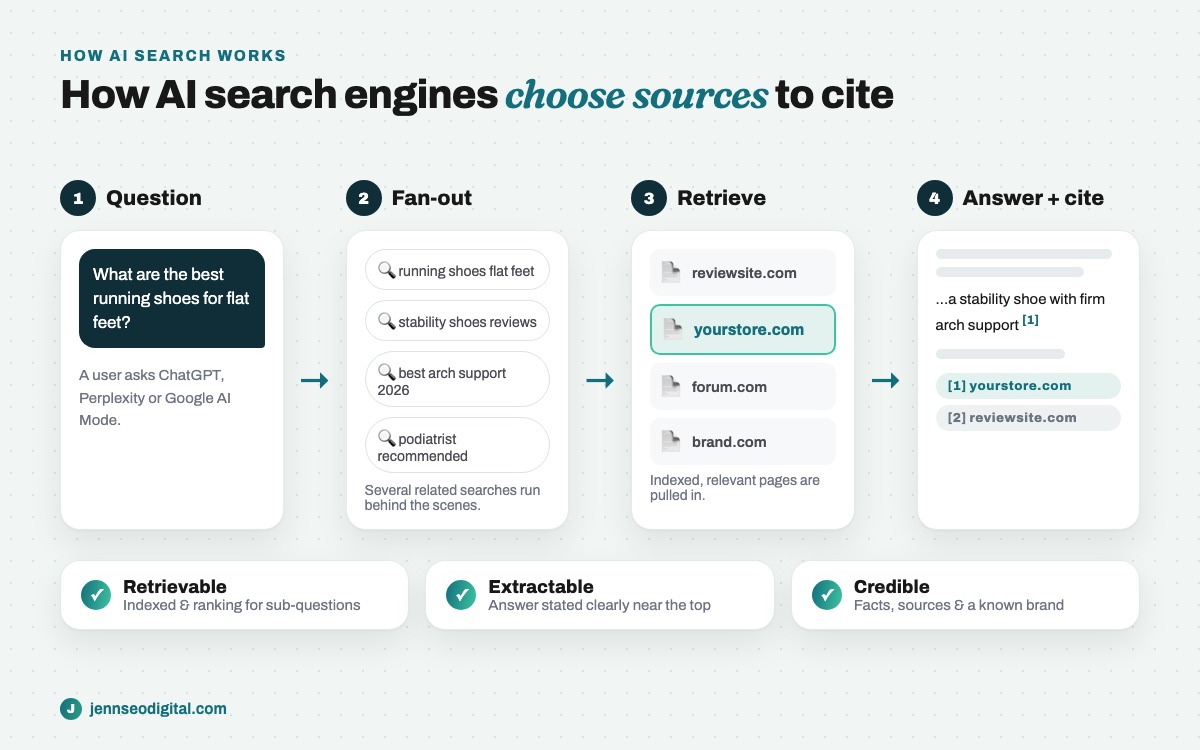
Google describes this process as “query fan-out”: AI Overviews and AI Mode may issue multiple related searches across subtopics to build a response, which surfaces a wider set of links than a classic results page. ChatGPT search and Perplexity work in a similar way, retrieving web results and showing the sources they used.
Three signals consistently make a page easier to cite:
- Retrievability: the page is indexed, crawlable and ranks for at least some of the sub-questions the AI is asking.
- Extractability: the answer is stated clearly near the top of a section, not buried in the fifth paragraph.
- Credibility: the content includes specific facts, statistics and named sources, and the brand behind it is mentioned consistently across trusted sites.
The bottom line is that you cannot buy or force an AI citation. You earn it by being the clearest, most trustworthy answer that is already in the search index.
Does Google Require Special Optimization for AI Overviews?
No. Google states that there are no additional requirements to appear in AI Overviews or AI Mode, and no special optimizations are necessary. A page only needs to be indexed and eligible to be shown in Google Search with a snippet — so the same SEO best practices that help you rank also make you eligible for AI features.
Google’s AI features documentation also notes that you do not need new AI text files or special schema markup. What it does recommend is the fundamentals: allow crawling, use internal links, keep important content in text, make sure structured data matches the visible page, and keep your Merchant Center and Google Business Profile details up to date.
This is good news for small businesses. You do not need a separate “AI budget” to start. You need a technically healthy site with content that answers your customers’ questions better than anyone else’s.
How to Optimize for GEO and AEO (Step by Step)
To optimize for GEO and AEO, start with a technically sound, indexed website, then rewrite key pages so each section answers one real question in its first sentences, add evidence and structured data, and build consistent brand mentions on trusted sites. The steps below work for both Google’s AI features and AI chatbots.
Step 1: Fix your technical foundation. Make sure your important pages are indexed in Google Search Console and Bing Webmaster Tools. ChatGPT search has historically drawn on Bing’s search results, so submitting your sitemap there matters too.
Step 2: Find the questions your customers ask. Use People Also Ask, AlsoAsked, Search Console queries and your own sales calls. Map each question to the page that should answer it.
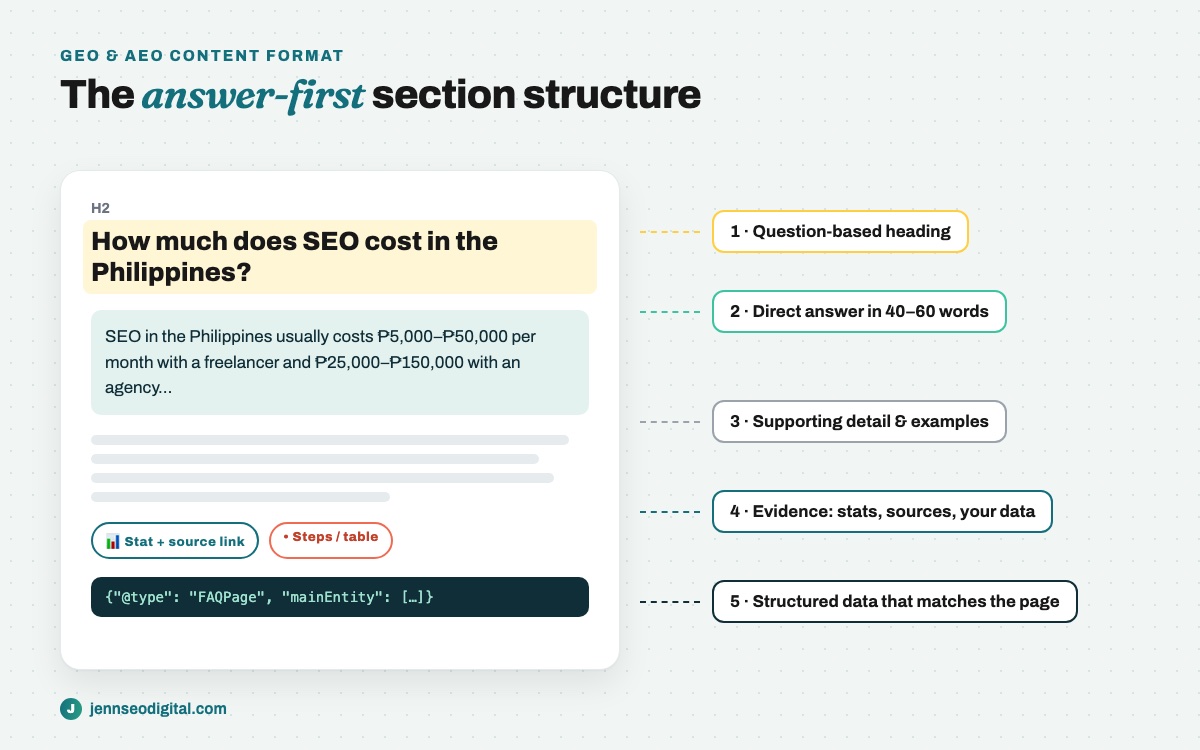
Step 3: Write answer-first sections. Use the question as an H2 or H3, then answer it directly in 40–60 words before adding detail. Each section should make sense on its own if an AI quotes only that part.
Step 4: Add evidence. Include specific numbers, dates, examples and links to credible sources. Your own data — such as client results or case studies — is the strongest evidence of all, because no one else can publish it.
Step 5: Make your brand an unambiguous entity. Use consistent business details everywhere, add Organization or LocalBusiness structured data, and link your website to your social and directory profiles so search engines and AI models connect them.
Step 6: Earn mentions on trusted sites. AI tools often lean on reviews, industry publications, directories and community discussions such as Reddit. Digital PR and genuine participation in those spaces increase the chance your brand is named.
Step 7: Optimize for each AI platform’s habits. ChatGPT optimization, Perplexity SEO and Google AI Overviews optimization share the same foundation but differ in which sources they tend to favour.
The key point is that every step above also improves classic SEO, so none of this work is wasted even if AI search changes again next year.
Which One Does Your Business Need: SEO, GEO or AEO?
Most businesses need all three, in this order: SEO first, because nothing else works without indexed, crawlable pages; AEO second, because answer-first content improves rankings and snippets immediately; and GEO third, because AI citations build on the authority and clarity the first two create.
The right balance depends on how your customers buy:
- Local service businesses (tradies, clinics, law firms) should prioritize local SEO and AEO, because “near me” searches and voice assistants drive calls.
- Ecommerce stores should prioritize ecommerce SEO for collection and product pages (see this Shopify SEO checklist), then GEO for comparison and “best product” questions people now ask ChatGPT.
- SaaS and B2B companies should invest early in GEO, because buyers increasingly ask AI tools for software shortlists and alternatives.
The bottom line is that you do not have to choose. A single well-planned content strategy can serve rankings, answers and AI citations together.
How Do You Measure AI Search Visibility?
You measure AI search visibility by combining Google Search Console data (which includes AI Overviews and AI Mode traffic), referral traffic from AI tools in Google Analytics 4, and regular checks of how AI assistants answer your most important questions. No single tool shows the full picture yet, so track trends rather than one number.
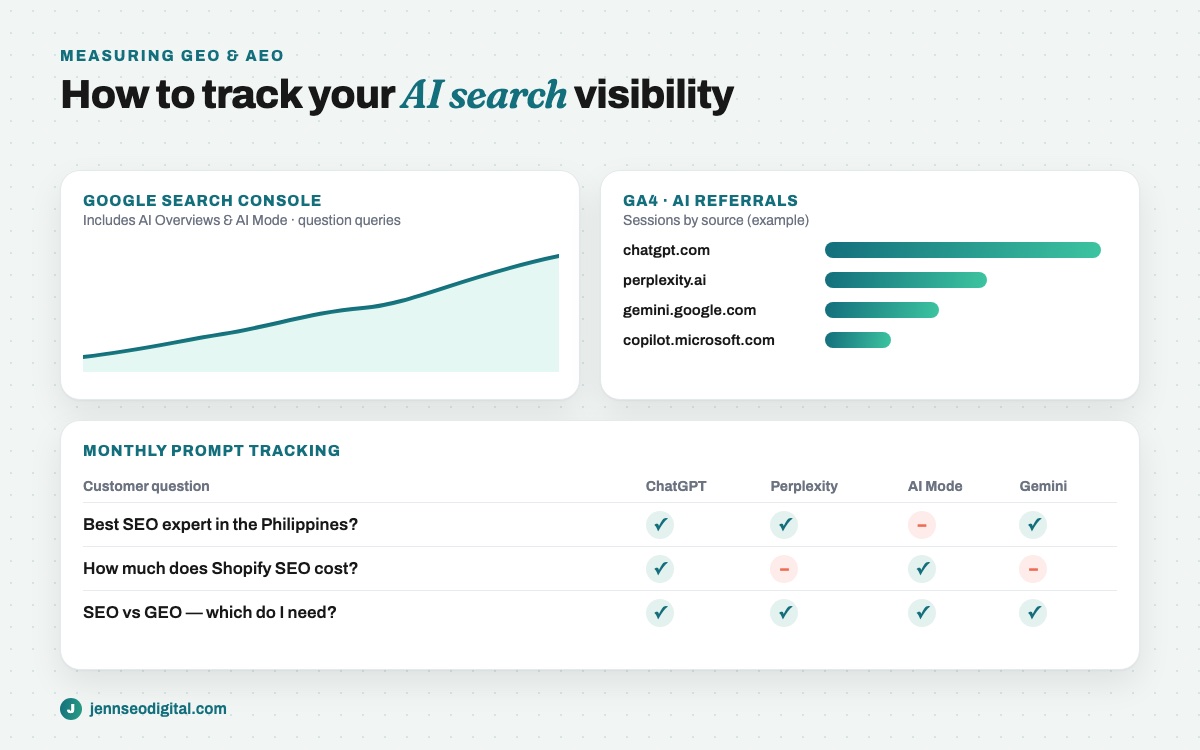
- Google Search Console: Google counts AI Overviews and AI Mode within your overall Search performance data, so watch impressions and clicks for question-based queries.
- Google Analytics 4: create a segment for referrals from sources such as chatgpt.com, perplexity.ai, gemini.google.com and copilot.microsoft.com.
- Prompt tracking: each month, ask the main AI tools your top 10–20 customer questions and record whether your brand is mentioned or cited.
- Brand mentions: monitor how often your business is named on review sites, directories and industry publications.
The key point is that AI visibility tends to follow brand authority, so steady growth in mentions and branded searches is usually the earliest sign that GEO is working. My SEO reporting includes these AI signals alongside traditional rankings.
Working With an SEO, GEO and AEO Specialist
If you want your business to show up in Google’s results, its answers and AI recommendations, it helps to work with someone who treats all three as one strategy. I’m Jenn, an SEO, GEO and AEO specialist based in Cebu City, Philippines, and my AI SEO services combine technical SEO, answer-first content and brand authority building.
You can see how this approach has worked for real businesses in my SEO case studies, including an automotive accessories store that reached $758K in organic revenue in 7 months. If you would like to know where your site stands today, request a free SEO audit and I will include an AI visibility check. Comparing specialists? Read how to hire an SEO expert in the Philippines.
Frequently Asked Questions
What is the difference between SEO and GEO?
SEO (search engine optimization) helps your pages rank in search engine results like Google and Bing. GEO (generative engine optimization) helps your brand get cited and recommended inside AI-generated answers from tools like ChatGPT, Perplexity and Google AI Mode. SEO competes for ranking positions; GEO competes to be one of the few sources an AI references.
Is AEO a part of GEO?
AEO and GEO overlap, but AEO is not strictly part of GEO. AEO (answer engine optimization) focuses on becoming the single direct answer in featured snippets, voice search and AI Overviews. GEO focuses on being cited in longer AI-generated answers. Both rely on clear, answer-first content, so work on one usually helps the other.
Is AI SEO the same as GEO?
AI SEO is an umbrella term that usually includes GEO and AEO. It describes any work that helps a business appear in AI-powered search, from Google AI Overviews to ChatGPT recommendations. GEO is the more specific term for optimizing content to be cited inside generative AI answers, and it comes from a 2023 research paper.
Will GEO replace SEO?
No, GEO will not replace SEO, because AI search depends on it. Google says pages only need to be indexed and eligible for a snippet to appear in AI Overviews, and most AI chatbots retrieve live search results before answering. Strong SEO is what makes your content available for AI tools to cite in the first place.
How do you integrate GEO with SEO?
You integrate GEO with SEO by running them as one content strategy. Keep your site technically healthy and indexed, target real customer questions, answer each one in the first 40–60 words of a section, support claims with sources and statistics, use matching structured data, and build consistent brand mentions on trusted websites.
Can ChatGPT do SEO?
ChatGPT can help with SEO tasks such as keyword brainstorming, content outlines, meta descriptions and schema drafts, but it cannot do SEO on its own. It cannot access your Search Console data, fix your website or build authority for you, and its suggestions need fact-checking by someone who understands search and your business.
Can you pay ChatGPT to recommend your business?
No, you cannot pay to change what ChatGPT recommends in its answers. OpenAI has said any ads it shows are kept separate from its responses and do not influence them. ChatGPT names brands based on the information it finds, such as websites, reviews and mentions on trusted sites, so build that through SEO, GEO and digital PR.